rkaf is an R package for Kolmogorov-Arnold Fourier Networks using the torch backend.
The package provides a modern R interface for KAF models, including:
- regression
- binary classification
- multiclass classification
- formula and matrix interfaces
- mini-batch training
- validation splits
- early stopping
- automatic standardization
- best-model restoration
- KAF-specific diagnostics
The goal of rkaf is to make KAF-style neural networks accessible to R users without requiring Python, reticulate, or custom training loops.
Installation
You can install the development version locally with:
devtools::install()Or from a local package directory:
devtools::load_all()rkaf depends on torch. If torch is not already configured, run:
torch::install_torch()Basic regression example
library(rkaf)

set.seed(123)
torch::torch_manual_seed(123)

x <- as.matrix(seq(-1, 1, length.out = 128))

y <- sin(8 * pi * x) +
  0.35 * cos(3 * pi * x) +
  0.15 * x^2

fit <- kaf_fit(
  x = x,
  y = y,
  hidden = c(256, 256),
  num_grids = 32,
  use_layernorm = FALSE,
  epochs = 1000,
  lr = 1e-3,
  standardize_x = FALSE,
  standardize_y = TRUE,
  fourier_init_scale = 5e-2,
  restore_best = TRUE,
  verbose = FALSE,
  seed = 123
)

fit
#> <kaf_fit>
#> Task:         regression
#> Architecture: 1 -> 256 -> 256 -> 1
#> Fourier grids: 32
#> Epochs:       1000
#> Batch size:   128
#> Validation:   no
#> Standardize x: no
#> Standardize y: yes
#> Final train loss: 0.0227977
#> Best train loss:  0.0198582 at epoch 945
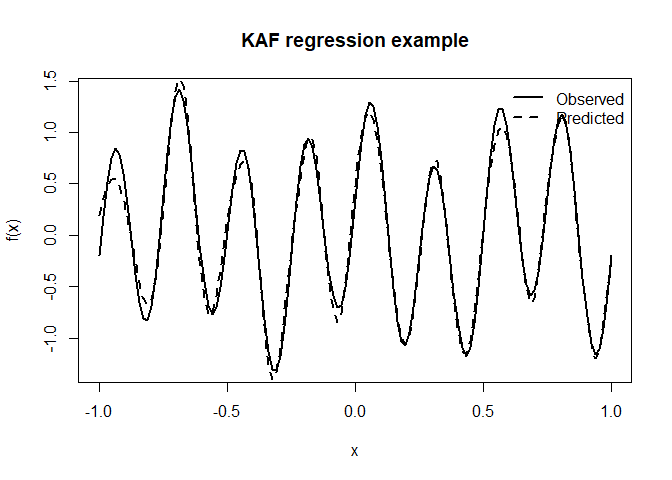
pred <- predict(fit, x)

plot(
  x,
  y,
  type = "l",
  lwd = 2,
  xlab = "x",
  ylab = "f(x)",
  main = "KAF regression example"
)

lines(x, pred, lwd = 2, lty = 2)

legend(
  "topright",
  legend = c("Observed", "Predicted"),
  lty = c(1, 2),
  lwd = 2,
  bty = "n"
)
plot(fit)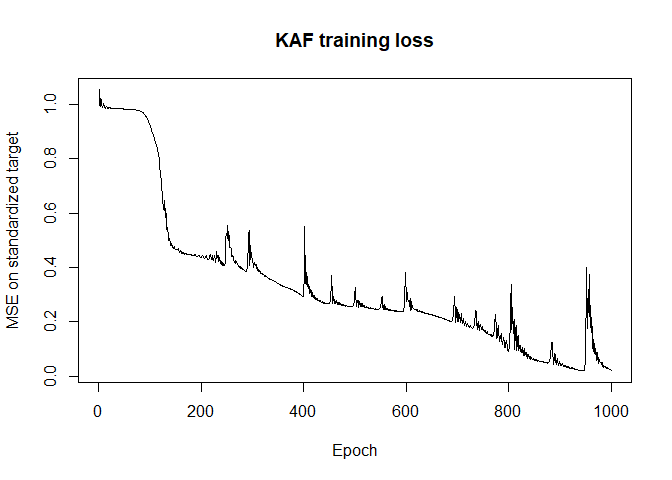
This example intentionally uses a Fourier-heavy target function to demonstrate the model’s ability to learn oscillatory structure.
Formula interface
rkaf also supports a formula interface for tabular data.
fit_mtcars <- kaf_fit_formula(
  mpg ~ wt + hp + cyl,
  data = mtcars,
  hidden = c(32, 32),
  num_grids = 16,
  epochs = 200,
  verbose = FALSE,
  seed = 123
)

fit_mtcars
#> <kaf_fit>
#> Task:         regression
#> Formula:      mpg ~ wt + hp + cyl
#> Architecture: 3 -> 32 -> 32 -> 1
#> Fourier grids: 16
#> Epochs:       200
#> Batch size:   32
#> Validation:   no
#> Standardize x: yes
#> Standardize y: yes
#> Final train loss: 0.0542788
#> Best train loss:  0.0542788 at epoch 200
mtcars_pred <- predict(fit_mtcars, mtcars)

head(data.frame(
  observed = mtcars$mpg,
  predicted = round(mtcars_pred, 2)
))
#>   observed predicted
#> 1     21.0     21.16
#> 2     21.0     21.15
#> 3     22.8     21.86
#> 4     21.4     20.03
#> 5     18.7     16.58
#> 6     18.1     18.30
Binary classification
For factor, character, or logical targets with two classes, rkaf can fit a binary classifier automatically.
df <- mtcars
df$high_mpg <- factor(
  ifelse(df$mpg > median(df$mpg), "yes", "no"),
  levels = c("no", "yes")
)

fit_binary <- kaf_fit_formula(
  high_mpg ~ wt + hp + cyl,
  data = df,
  hidden = c(32, 32),
  num_grids = 16,
  epochs = 200,
  verbose = FALSE,
  seed = 123
)

fit_binary
#> <kaf_fit>
#> Task:         binary
#> Classes:      no, yes
#> Formula:      high_mpg ~ wt + hp + cyl
#> Architecture: 3 -> 32 -> 32 -> 1
#> Fourier grids: 16
#> Epochs:       200
#> Batch size:   32
#> Validation:   no
#> Standardize x: yes
#> Standardize y: no
#> Final train loss: 0.00163561
#> Best train loss:  0.00163561 at epoch 200
Predicted probabilities and class:
prob_binary <- predict(fit_binary, df, type = "prob")
class_binary <- predict(fit_binary, df, type = "class")

head(data.frame(
  observed = df$high_mpg,
  prob_yes = round(prob_binary, 3),
  predicted = class_binary
))
#>   observed prob_yes predicted
#> 1      yes    0.999       yes
#> 2      yes    0.999       yes
#> 3      yes    1.000       yes
#> 4      yes    0.983       yes
#> 5       no    0.000        no
#> 6       no    0.008        no

table(
  observed = df$high_mpg,
  predicted = class_binary
)
#>         predicted
#> observed no yes
#>      no  17   0
#>      yes  0  15
Multiclass classification
For factor targets with more than two classes, rkaf fits a multiclass model.
fit_iris <- kaf_fit_formula(
  Species ~ .,
  data = iris,
  hidden = c(32, 32),
  num_grids = 16,
  epochs = 300,
  verbose = FALSE,
  seed = 123
)

fit_iris
#> <kaf_fit>
#> Task:         multiclass
#> Classes:      setosa, versicolor, virginica
#> Formula:      Species ~ .
#> Architecture: 4 -> 32 -> 32 -> 3
#> Fourier grids: 16
#> Epochs:       300
#> Batch size:   150
#> Validation:   no
#> Standardize x: yes
#> Standardize y: no
#> Final train loss: 0.00819381
#> Best train loss:  0.00819381 at epoch 300
Class probabilities:
head(round(predict(fit_iris, iris, type = "prob"), 3))
#>      setosa versicolor virginica
#> [1,]  0.999      0.001     0.000
#> [2,]  0.995      0.003     0.002
#> [3,]  0.997      0.001     0.001
#> [4,]  0.997      0.001     0.001
#> [5,]  0.999      0.000     0.000
#> [6,]  1.000      0.000     0.000
Predicted classes:
Validation and early stopping
kaf_fit() supports validation splits, mini-batching, and early stopping.
fit_val <- kaf_fit(
  x = x,
  y = y,
  hidden = c(64, 64),
  num_grids = 16,
  use_layernorm = FALSE,
  epochs = 300,
  lr = 5e-4,
  batch_size = 64,
  validation_split = 0.2,
  patience = 100,
  restore_best = TRUE,
  verbose = FALSE,
  seed = 123
)

fit_val$train_loss_history
fit_val$validation_loss_history
The fitted object stores both training and validation loss histories, so users can inspect them directly through fit_val$train_loss_history and fit_val$validation_loss_history. The code above is shown as an example and is not run when building this README.
KAF diagnostics
You can inspect the learned balance between the base/GELU branch and the Fourier branch.
scales <- extract_kaf_scales(fit)
head(scales)
#>   layer feature base_scale fourier_scale fourier_to_base_ratio
#> 1     1       1  1.0369691    0.11137812            0.10740737
#> 2     2       1  0.9652719    0.15750510            0.16317174
#> 3     2       2  0.9738784    0.39944243            0.41015638
#> 4     2       3  0.9945174    0.12360517            0.12428658
#> 5     2       4  0.9936960    0.08714252            0.08769535
#> 6     2       5  1.0083405    0.08873361            0.08799965
fourier_params <- extract_fourier_params(fit, layer = 1)
head(fourier_params)
#>   layer input_feature grid     weight      bias
#> 1     1             1    1  0.1379520 4.5462580
#> 2     1             1    2 -0.1811931 4.3979001
#> 3     1             1    3 -0.1297648 5.7381864
#> 4     1             1    4 -0.4164377 2.7132401
#> 5     1             1    5  0.3679259 0.4899397
#> 6     1             1    6  0.3606938 2.3420620
Low-level torch interface
Advanced users can directly create KAF torch modules.
model <- nn_kaf(
  layers = c(4, 16, 16, 1),
  num_grids = 8
)

x_tensor <- torch::torch_randn(10, 4)
y_tensor <- model(x_tensor)

y_tensor$shape
#> [1] 10  1
Current package status
The package currently includes:
with full test coverage for the core API, including regression, binary classification, multiclass classification, formula handling, prediction, training utilities, and diagnostics.
References and attribution
rkaf is an independent R implementation of Kolmogorov-Arnold Fourier Networks using the torch backend.
The package is based on the KAF architecture proposed in:
Zhang, J., Fan, Y., Cai, K., & Wang, K. (2025).
Kolmogorov-Arnold Fourier Networks.
arXiv:2502.06018.
The implementation was also informed by the public Python reference implementations:
kolmogorovArnoldFourierNetwork/KAFkolmogorovArnoldFourierNetwork/kaf_act
No Python dependency is required by rkaf.